Table of Contents
- Why Private Well Owners Should Test for PFAS in 2026
- What You'll Need Before You Test Well Water for PFAS
- Step-by-Step: How to Collect Your Well Water Sample
- PFAS Sampling Best Practices for Accurate Results
- How to Find Certified PFAS Water Testing Labs
- How to Interpret PFAS Water Test Results
- What to Do If PFAS Is Detected in Your Well Water
- Conclusion: Next Steps for a Safer Water Supply
- Frequently Asked Questions
Last Updated: October 2, 2026
Why Private Well Owners Should Test for PFAS in 2026
If you drink from a private well, no agency checks your water for you. That job belongs to you, and PFAS is one of the hardest contaminants to spot.
Private wells serve millions of households across the country, and most of them fall outside federal drinking water rules.
Healthy Water Solutions LLC helps families figure out what is actually in their water before they spend money on filters.
What You'll Need Before You Test Well Water for PFAS
Getting a clean sample starts with the right supplies. Most certified labs sell a kit built for PFAS testing, and you should use theirs rather than your own bottles.
Here is what your kit will typically include:
- Lab-certified sample bottles, usually plastic
- Pre-cleaned caps and seals
- Chain of custody paperwork
- Shipping materials and labels
- Step-by-step sampling instructions
Do not swap in a glass jar from your kitchen. PFAS can cling to the wrong container and skew your numbers. Skip lotions, sunscreen, and waterproof clothing on sampling day too, since some of those products contain the very chemicals you are testing for.
Step-by-Step: How to Collect Your Well Water Sample
A clean sample decides whether your results mean anything. Follow the kit directions closely, because PFAS sampling is stricter than a standard bacteria test.
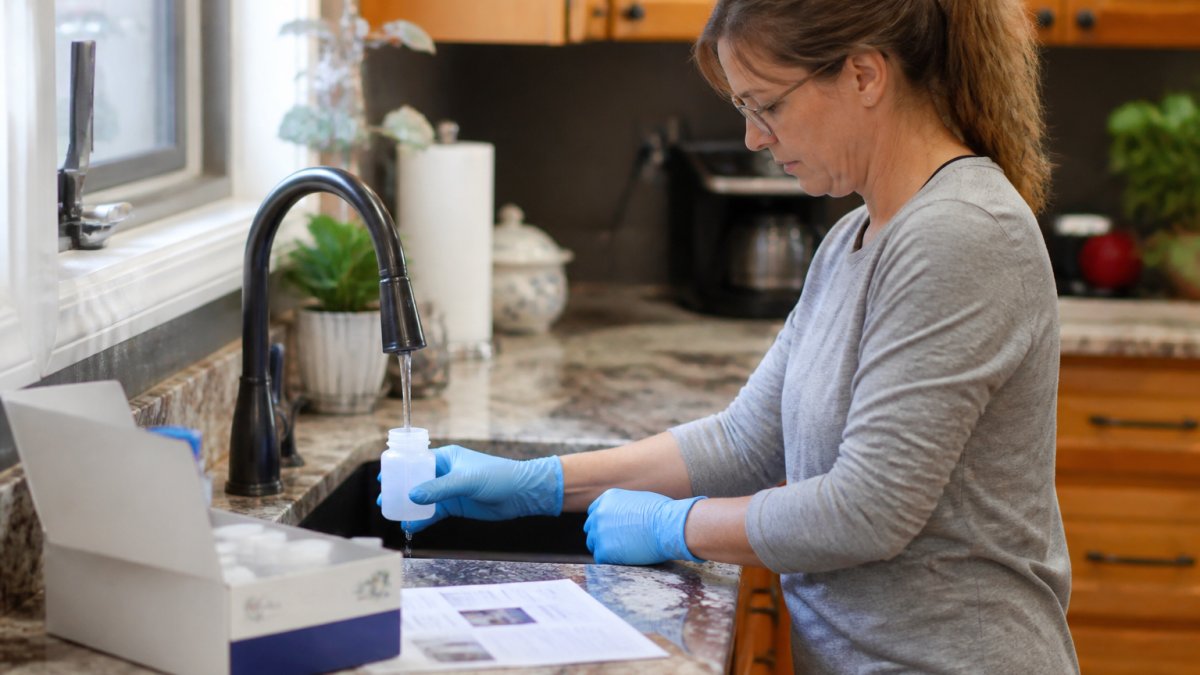
- Pick the right tap. Use a kitchen or bathroom faucet with no filter, aerator, or softener attached.
- Remove the aerator screen and set it aside.
- Run cold water for several minutes to flush the line.
- Put on clean gloves before you touch the bottle.
- Open the bottle and fill it without letting the cap touch anything.
- Cap it tight, then label it with your name, date, and time.
- Seal it in the shipping bag and send it to the lab the same day.
Avoiding Sample Contamination
Contamination is the number one reason PFAS tests come back wrong. The chemicals sit on everyday items, so your hands, clothes, and tools can all add PFAS to a sample.
Keep these habits on sampling day:
- Wear nitrile gloves, not latex
- Avoid new clothing, especially anything stain-resistant
- Skip fast food wrappers and greasy takeout before you sample
- Do not use bug spray, lotion, or cosmetics
- Keep pets away from your workspace
A common mistake is sampling right after handling packaged food or coated paper. Wash your hands, change gloves, and start again if that happens.
PFAS Sampling Best Practices for Accurate Results
Timing and handling matter as much as technique. Send your sample to the lab within the window your kit allows, since delayed samples can shift the reading.
Follow these PFAS sampling best practices:
- Collect from the same tap every time you test
- Sample before any filter or softener
- Record the date, time, and weather in your notes
- Keep samples cool and out of sunlight
- Ship overnight when the lab asks for it
Baseline testing gives you a starting point. If you test again in a year, you can compare the two reports side by side and see whether anything changed. That pattern tells you more than a single test ever could.
How to Find Certified PFAS Water Testing Labs
Certified PFAS water testing labs use EPA-approved methods and can measure PFAS down to parts per trillion. That unit matters, because the EPA's federal Maximum Contaminant Levels (MCLs) for PFOA and PFOS are set at 4.0 parts per trillion, though those requirements apply to regulated public water systems rather than private wells. Private well owners can still use the federal values as reference points, and some states set their own recommendations or action levels that are worth checking too, since PFAS regulation keeps evolving. But "certified" means different things depending on where your well sits, and that is where most guides stop short.
The Two Paths: State Programs vs. Private Accredited Labs
Before you buy a kit, find out which path your state uses. Regulations vary wildly by region, and picking the wrong path can mean paying for a test your state would have run for free, or waiting on a program that does not serve private wells at all.
- State-run PFAS testing programs. A growing number of states fund free or reduced-cost PFAS testing for private well owners, usually through the state health or environmental agency. These programs often target wells near known contamination sources, fire training areas, landfills, industrial sites, and military bases. If your state has one, apply first. The catch is that state programs typically test only a fixed panel of compounds and may not report the full breakdown you need to size a filter.
- Private accredited labs. If your state has no program, or your well falls outside the program's target area, you go private. Look for a lab accredited by a recognized drinking water accreditation body and specifically approved for PFAS analysis under EPA Method 533 or EPA Method 537.1.
How to Look Up Your State's Program
There is no single national directory, so use this lookup sequence:
- Search your state health department's website for "private well PFAS testing."
- Check your state environmental agency for a "PFAS response" or "site investigation" page.
- Call your county health department and ask two questions: Does the state test private wells for PFAS? Is my address in a priority area?
- If the answer is no on both, move to the private lab path.
A common pattern is that states with known industrial or military contamination have the most developed programs, while states with less documented contamination offer little or nothing. That does not mean your well is safe, it means the burden shifts to you.
Markers of a Qualified Private Lab
When you go private, screen the lab on these points. For homeowners who want professional laboratory analysis instead of relying on a basic screening kit, you can explore Certified Lab Testing for available water-testing options.
- Accreditation for PFAS specifically, not just "organics" or "volatiles"
- EPA methodology listed on the report (533 or 537.1)
- A clear chain of custody process
- Sample preservation and hold-time instructions included with the kit
- Reports written in plain language, with each compound listed separately
The EPA's list of approved drinking water methods shows which analytical methods labs should use. EPA Method 537.1 analyzes 18 PFAS compounds and EPA Method 533 analyzes 25, and together the two methods cover 29 unique PFAS. Not every private lab runs both methods, so ask which method yours uses, which PFAS are included in that panel, what the reporting limits are, and whether the lab is properly certified or accredited for this testing. If a company cannot tell you its method or its accreditation body, keep looking.
What to Expect From Each Path
Path | Who pays | Typical panel | Best for |
|---|---|---|---|
State program | State agency | Varies by state program; often a fixed list | Wells near known contamination |
Private accredited lab | You | Varies by lab and analytical method | Any well, full breakdown |
National mail-in kit | You | Varies; verify method | Convenience, but confirm accreditation |
Whichever path you choose, confirm the lab's hold time and shipping window before you collect. A sample that sits too long can shift the reading, and no amount of lab quality fixes a late shipment.
Ready to get a clearer picture of what is in your water? Explore Certified Lab Testing to review professional water-testing options.
How to Interpret PFAS Water Test Results
Your report lists each chemical and its concentration. The number to watch is parts per trillion, often shortened to ppt. One part per trillion is like a single drop of water in 20 Olympic-size swimming pools, so small that the lab needs specialized equipment to see it at all. That scale is why a result that looks like a tiny decimal can still matter.
How to Read the Report, Line by Line
Most PFAS lab reports follow the same structure. Here is what each column means and what to look for.
- Analyte / Compound name. The specific PFAS chemical, such as PFOA, PFOS, PFHxS, or PFNA. Each one is reported separately. Do not average them in your head.
- Result. The concentration found, usually in nanograms per liter (ng/L), which is the same as parts per trillion. A result of "5.2 ng/L" is 5.2 ppt.
- Reporting limit (RL) or method detection limit (MDL). The lowest concentration the lab can reliably measure. If your result is below this number, the report will say "ND" (not detected) or "< RL."
- Method. The EPA method used, typically 533 or 537.1. Method 537.1 analyzes 18 PFAS and Method 533 analyzes 25, together covering 29 unique PFAS, though not every lab runs both. Check which method your lab used, which PFAS are included in the panel, the lab's reporting limits, and whether the lab is certified or accredited for PFAS testing.
- Regulatory level. Some reports print a comparison column. EPA has set federal Maximum Contaminant Levels (MCLs) for several PFAS under the National Primary Drinking Water Regulation. These apply to regulated public water systems: private wells are generally not subject to those compliance requirements, though well owners can still use the federal levels as a reference point. State recommendations or action levels may differ and should also be checked. PFAS regulation keeps evolving, so confirm the current EPA and state guidance for the compounds in your report.
What "Not Detected" Actually Means
A "not detected" result means the compound fell below the lab's reporting limit. It does not always mean zero. Different labs use different limits, so a low-level result from one lab may not appear on another.
This is why comparing two reports from different labs can be misleading. Always compare results from the same lab, using the same method, when you are tracking changes over time.
The Numbers That Matter Most
PFOA and PFOS draw the most regulatory attention because they carry federal Maximum Contaminant Levels. Your report may include many more PFAS, and some of them matter too:
- PFOA and PFOS, which have federal Maximum Contaminant Levels
- PFHxS, PFNA, HFPO-DA (GenX), PFBS, and others, which may also be relevant depending on federal and state guidance, the test method used, and your location
If PFOA or PFOS appear above the federal Maximum Contaminant Level of 4.0 parts per trillion, that is your signal to act. PFAS regulations continue to evolve: PFOA and PFOS remain especially important federal reference points, while requirements affecting PFHxS, PFNA, HFPO-DA (GenX), and a combined Hazard Index have been subject to additional EPA rulemaking. Other compounds on the report still matter for treatment sizing, so confirm the current EPA and state guidance for everything detected in your water.
A Simple Way to Read Any Report
- Find PFOA, PFOS, and any other PFAS your report lists. Note each result in ppt.
- Check the reporting limit next to each. If the result is "ND" but the limit is high, flag it.
- Look up the current federal Maximum Contaminant Level for each compound, 4.0 ppt for PFOA and PFOS, plus your state's level, since state requirements can differ.
- Compare each result to the applicable federal or state level, compound by compound.
- Write down which compounds were detected and at what levels. That list is what a treatment specialist needs.
If you want help reading the numbers, the Agency for Toxic Substances and Disease Registry publishes plain-language background on PFAS and health. A WQA Certified Water Specialist can also walk you through your report line by line and translate the numbers into a treatment plan. For homeowners who want professional laboratory analysis instead of relying on a basic screening kit, you can explore Certified Lab Testing for available water-testing options.
What to Do If PFAS Is Detected in Your Well Water
A detection is not a reason to panic. It is a reason to act with a plan. First, confirm the result with a second sample if the level sits near a federal Maximum Contaminant Level or state action level.
Then match your treatment to the chemistry:
- Activated carbon binds many PFAS compounds and works well for lower levels
- Reverse osmosis pushes water through a fine membrane and catches a broad range of PFAS
- Ion exchange resins are built to grab specific PFAS compounds
- Point-of-use units treat one tap, while whole-house systems treat everything
No single filter handles every situation. The right choice depends on which compounds showed up and at what levels. Healthy Water Solutions LLC reviews your lab report and recommends a system that fits your results, not a one-size-fits-all package.
Test first, treat second. Buying a filter before you know your PFAS levels often means paying for capacity you do not need, or missing the compound that is actually present.
Ready to get a clearer picture of what is in your water? Explore Certified Lab Testing to review professional water-testing options.
Conclusion: Next Steps for a Safer Water Supply
Testing your well for PFAS comes down to a clean sample, a certified lab, and a clear read of the report. Guessing wastes money and leaves your family exposed. Data removes the guesswork. Healthy Water Solutions LLC offers certified lab water testing, WQA Certified Water Specialist guidance, and personalized strategy calls so you can pick the right filtration system the first time. Ready to get a clearer picture of what is in your water? Explore Certified Lab Testing to review professional water-testing options.
Frequently Asked Questions
Can I test my well water for PFAS myself with a home kit?
Yes, but only with a lab-certified kit. Home test strips are not reliable for PFAS because detection limits are measured in parts per trillion. A certified laboratory kit includes a sampling container, chain of custody form, and instructions for proper sample preservation. You collect the sample at home and ship it to the lab for chemical analysis using EPA methodology. This gives you defensible results you can act on.
What EPA methods are used for PFAS water testing?
EPA Method 537.1 and EPA Method 533 are the primary methods for drinking water. Method 537.1 detects 18 PFAS compounds, while Method 533 targets 25 compounds including short-chain PFAS. Both use solid-phase extraction and liquid chromatography-tandem mass spectrometry. Your certified laboratory will tell you which method they use, and that determines which PFAS compounds show up in your report.
How do I find a certified laboratory for PFAS testing?
Search for labs accredited by state environmental agencies or certified under the EPA's method approval process. The lab should provide a chain of custody form and clear sampling instructions. Ask whether they participate in proficiency testing for PFAS. A WQA Certified Water Specialist can also point you to reputable labs and help you choose the right test panel for your well.
What can remove PFAS from my well water?
Activated carbon filters and reverse osmosis systems are the most common treatment options. Granular activated carbon adsorbs PFAS compounds, while reverse osmosis forces water through a semipermeable membrane that blocks them. Point-of-use systems treat water at one tap, while whole-house systems treat all water entering your home. Test first, then match the filtration system to what your lab report actually shows.
Frequently Asked Questions
Can I test my well water for PFAS myself with a home kit?
Yes, but only with a lab-certified kit. Home test strips are not reliable for PFAS because detection limits are measured in parts per trillion. A certified laboratory kit includes a sampling container, chain of custody form, and instructions for proper sample preservation. You collect the sample at home and ship it to the lab for chemical analysis using EPA methodology. This gives you defensible results you can act on.
What EPA methods are used for PFAS water testing?
EPA Method 537.1 and EPA Method 533 are the primary methods for drinking water. Method 537.1 detects 18 PFAS compounds, while Method 533 targets 25 compounds including short-chain PFAS. Both use solid-phase extraction and liquid chromatography-tandem mass spectrometry. Your certified laboratory will tell you which method they use, and that determines which PFAS compounds show up in your report.
How do I find a certified laboratory for PFAS testing?
Search for labs accredited by state environmental agencies or certified under the EPA's method approval process. The lab should provide a chain of custody form and clear sampling instructions. Ask whether they participate in proficiency testing for PFAS. A WQA Certified Water Specialist can also point you to reputable labs and help you choose the right test panel for your well.
What can remove PFAS from my well water?
Activated carbon filters and reverse osmosis systems are the most common treatment options. Granular activated carbon adsorbs PFAS compounds, while reverse osmosis forces water through a semipermeable membrane that blocks them. Point-of-use systems treat water at one tap, while whole-house systems treat all water entering your home. Test first, then match the filtration system to what your lab report actually shows.