Table of Contents
- Why Test Your Well Water
- Private Well Water Testing Frequency
- How to Collect a Water Sample
- Choosing a Certified Laboratory
- How to Interpret Well Water Test Results
- Dangers of Microplastics in Drinking Water
- What to Do If Contaminants Are Found
- Frequently Asked Questions
Last Updated: September 24, 2026
Why Test Your Well Water
Roughly one in five households in the U.S. relies on a private well for drinking water, and private wells are not covered by the Safe Drinking Water Act. That means no one else is checking your water. You are the regulator, the tester, and the decision-maker for your own supply.
This guide from Toxin Free with Rob / Healthy Water Solutions LLC walks you through how to test home well water the right way: what to test for, how to pull a clean sample, and how to read the lab report once it lands in your inbox.
Here's the part most guides skip. Your water can look clear, taste fine, and still carry arsenic, bacteria, or nitrates at levels that matter over years, not days. The CDC guidance on private well testing makes this point plainly: you cannot see, taste, or smell most contaminants.
So testing is not about fixing a problem you already noticed. It is about finding problems before they find you.
Private Well Water Testing Frequency
Private well water testing frequency comes down to one rule: test every year for bacteria and nitrates, no matter what. Those two are the baseline. Everything else depends on your well, your area, and what you find.
Annual Testing Basics
Once a year, run the core panel:
- Total coliform bacteria (a sign of surface water getting in)
- Nitrates and nitrites (common near farms and septic systems)
- pH level (affects how plumbing and treatment systems perform)
If you have young children, nitrates deserve extra attention. Infants are the most vulnerable group, and nitrate problems often show up with no warning signs at all.
Special Circumstances for Testing
Test more often, or add tests, when:
- You notice a change in taste, smell, or color
- A neighbor's well turns up a problem
- You install or replace a water treatment system
- Flooding, heavy rain, or nearby construction occurs
- Anyone in the home gets recurring stomach illness
A sanitary survey also helps here. That's a walk-through of your wellhead, casing, and surrounding land to spot cracks, loose caps, or contamination risks before they reach your water.
How to Collect a Water Sample
A clean sample is the difference between a useful result and a wasted lab fee. Most bad results trace back to the sampling step, not the water itself.
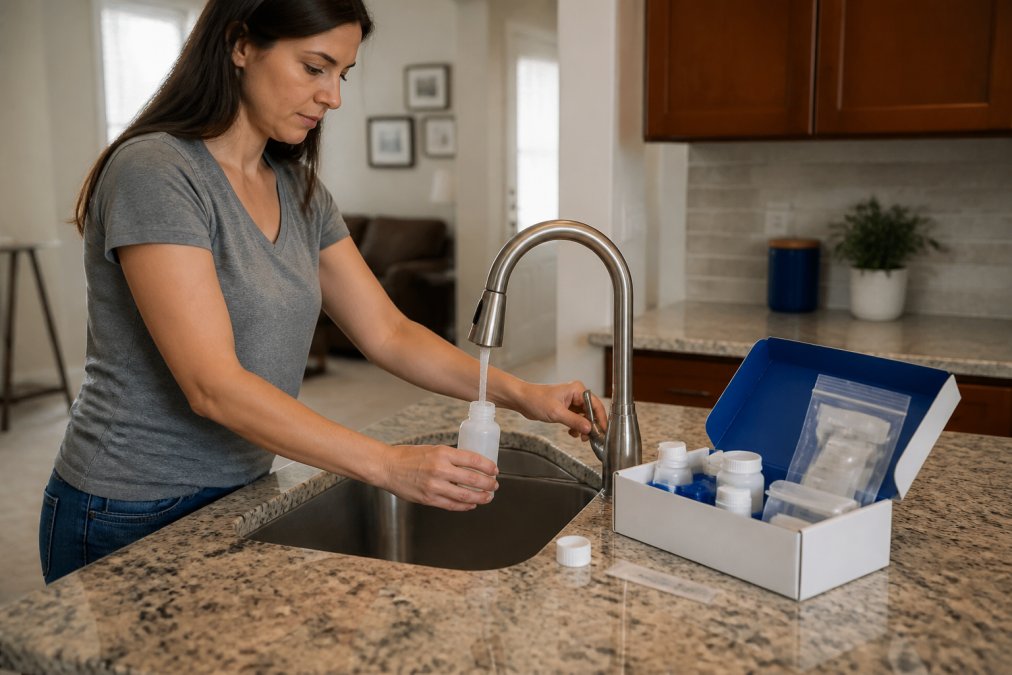
Step-by-Step Sampling Protocol
- Get the right bottle. Use the sterile bottle the lab provides. Never rinse it out or reuse a jar.
- Pick the right tap. Use a cold-water tap with no filter, softener, or aerator attached.
- Remove the screen. Unscrew the aerator and set it aside.
- Flush the line. Run cold water for several minutes to clear standing water from the pipes.
- Sanitize the spout. Wipe the faucet tip with an alcohol pad and let it dry.
- Fill carefully. Open the bottle and fill to the line without touching the inside of the cap or bottle.
- Cap and chill. Seal it, label it, and keep it cold until you drop it off.
Choosing a Certified Laboratory
Choosing a certified laboratory is the step that makes or breaks your results. A certified lab follows strict methods, uses proper equipment, and reports results you can act on.
What "Certified" Actually Means
In practice, a lab earns certification through two layers:
- State certification. Because private wells fall outside the Safe Drinking Water Act, states run their own drinking water laboratory certification programs. Your state health or environmental agency maintains the approved list.
- National accreditation. Many labs also hold accreditation through programs like NELAP (the National Environmental Laboratory Accreditation Program), which audits methods, quality control, and staff competency.
A lab can be certified for some contaminants and not others. Always confirm the specific analytes you need are on their certification scope.
How to Verify a Lab
- Pull your state's approved lab list from the health department website.
- Confirm the lab's certification covers the contaminants you're testing for.
- Ask for their certification number and the method they'll use.
- Check turnaround time and whether they provide a written interpretation.
The EPA's private well testing resources points homeowners toward state programs that certify labs for private well analysis.
What to Ask Before You Commit
- Are you certified for the specific contaminants I need tested?
- What method will you use, and what's the reporting limit?
- How long until I get results?
- Do you explain the report, or just hand over numbers?
- Can you test for volatile organic compounds, heavy metals, and PFAS if needed?
Cost Reality
A basic bacteria-and-nitrate test, while a full panel covering metals, VOCs, and PFAS costs considerably more. A cheap kit that skips certification is not a bargain. It's a guess.
How to Interpret Well Water Test Results
How to interpret well water test results starts with one number: the lab's reporting limit. If a result reads "ND" (not detected), that means the contaminant wasn't found above the level the test can reliably measure. It does not always mean zero.
Reading the Actual Report
Most certified labs send back a multi-page PDF, and the layout trips people up. Here's how to walk through it:
- Find the sample ID and collection date. Confirm it matches your bottle and the day you pulled the sample. A mismatch means the report isn't yours.
- Locate the method column. Each contaminant is tested by a specific method (for example, EPA Method 200.8 for metals or SM 9223 B for coliform). The method tells you the detection capability.
- Read the result and the reporting limit side by side. A result of "<0.001 mg/L" means below the reporting limit, not necessarily zero.
- Compare against the MCL or SMCL column. Maximum Contaminant Levels are health-based; Secondary Maximum Contaminant Levels are aesthetic (taste, odor, staining).
- Check the units. Arsenic is often reported in µg/L (ppb), while nitrate is reported in mg/L (ppm). Mixing these up is a common error.
What the Numbers Actually Mean
- At or below the standard: generally fine, keep monitoring
- Above the standard: act, and re-test to confirm
- Between detection and the standard: note it, watch the trend over time
A few units worth memorizing: 1 mg/L equals 1 ppm, and 1 µg/L equals 1 ppb. The arsenic MCL is 10 µg/L (0.010 mg/L). The nitrate MCL is 10 mg/L as nitrogen. The lead action level is 0.015 mg/L. Knowing these lets you sanity-check a report in seconds.
The Trend Is the Story
The EPA's drinking water standards set the maximum contaminant levels labs compare against. Keep every report. A single result is a snapshot.
If a result is confusing, call the lab. Certified labs employ chemists who will explain a report line by line, that service is part of what you paid for.
Dangers of Microplastics in Drinking Water
The dangers of microplastics in drinking water are still being studied, but the concern is real. Microplastics are tiny plastic particles that shed from bottles, pipes, and packaging. They've been found in groundwater, tap water, and bottled water alike.
What to Do If Contaminants Are Found
Work through it in order:
- Confirm the result. Re-test to rule out a sampling error.
- Find the source. Is it the well, the plumbing, or the aquifer?
- Match the fix to the finding. Bacteria calls for shock chlorination; arsenic calls for a specific filter media; nitrates call for a different approach entirely.
- Validate the system. After installing treatment, re-test to confirm it's actually working.
If you'd rather not sort through lab reports alone, Toxin Free with Rob / Healthy Water Solutions LLC offers certified lab water testing and a strategy call to translate the numbers into a clear plan for your home.
Frequently Asked Questions
Can I test my well water myself at home?
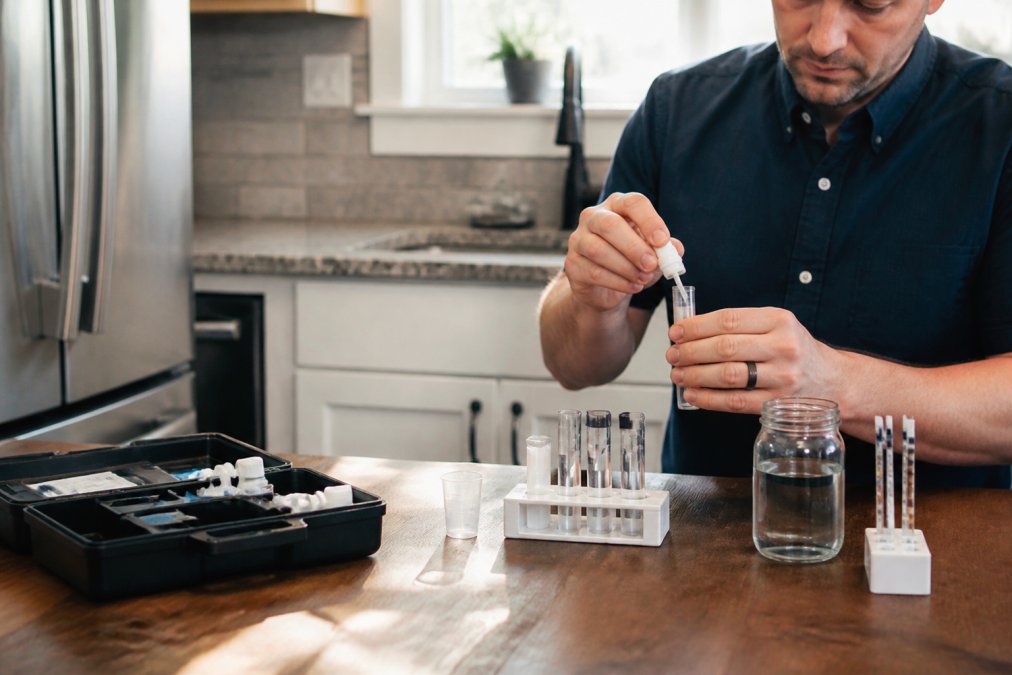
You can use home test kits for basic screening of parameters like pH, total coliform bacteria, and nitrates. However, these kits are not as accurate as certified laboratory analysis. For a comprehensive understanding of your water quality, including heavy metals, volatile organic compounds, and PFAS, you should collect a sample and send it to a state-certified laboratory. A professional test provides the reliable data needed to make informed decisions about treatment.
How often should I test my private well water?
Test your private well water for total coliform bacteria and nitrates every year. Perform a more comprehensive test for pH, total dissolved solids, and other contaminants every three to five years. You should also test immediately if you notice a change in taste, odor, or color, if you replace any part of the well system, or if a neighboring well has a known contamination issue. Following this private well water testing frequency helps ensure your water remains safe.
What are the most common contaminants in private wells?
Common contaminants include total coliform bacteria, nitrates from fertilizers or septic systems, and heavy metals like lead and arsenic. Other risks are sulfates, pesticides, and volatile organic compounds. The specific contaminants depend on your local geology and land use. A certified laboratory can test for a broad panel of these substances, giving you a clear picture of your water quality and any necessary treatment steps.
How do I interpret my well water test results?
Your lab report will list each contaminant with its result and the EPA's maximum contaminant level (MCL) or a health advisory. Compare your numbers to these standards. If a result is below the limit, your water is considered safe for that substance. If it exceeds the limit, you should consult a water quality specialist to determine the best treatment option, such as a reverse osmosis system or a whole-house filter. Learning how to interpret well water test results is key to protecting your family's health.
Frequently Asked Questions
Can I test my well water myself at home?
You can use home test kits for basic screening of parameters like pH, total coliform bacteria, and nitrates. However, these kits are not as accurate as certified laboratory analysis. For a comprehensive understanding of your water quality, including heavy metals, volatile organic compounds, and PFAS, you should collect a sample and send it to a state-certified laboratory. A professional test provides the reliable data needed to make informed decisions about treatment.
How often should I test my private well water?
Test your private well water for total coliform bacteria and nitrates every year. Perform a more comprehensive test for pH, total dissolved solids, and other contaminants every three to five years. You should also test immediately if you notice a change in taste, odor, or color, if you replace any part of the well system, or if a neighboring well has a known contamination issue. Following this private well water testing frequency helps ensure your water remains safe.
What are the most common contaminants in private wells?
Common contaminants include total coliform bacteria, nitrates from fertilizers or septic systems, and heavy metals like lead and arsenic. Other risks are sulfates, pesticides, and volatile organic compounds. The specific contaminants depend on your local geology and land use. A certified laboratory can test for a broad panel of these substances, giving you a clear picture of your water quality and any necessary treatment steps.
How do I interpret my well water test results?
Your lab report will list each contaminant with its result and the EPA's maximum contaminant level (MCL) or a health advisory. Compare your numbers to these standards. If a result is below the limit, your water is considered safe for that substance. If it exceeds the limit, you should consult a water quality specialist to determine the best treatment option, such as a reverse osmosis system or a whole-house filter. Learning how to interpret well water test results is key to protecting your family's health.