Table of Contents
- What Hard Water Actually Does to Your Home
- Signs of Hard Water You Can Spot This Week
- How to Test Water Hardness at Home
- Water Softener vs Water Conditioner: What's the Difference?
- The Real Costs: DIY vs Professional Installation
- When a Water Softener Isn't the Answer
- Frequently Asked Questions
Last Updated: September 23, 2026
What Hard Water Actually Does to Your Home
If you've scrubbed a chalky film off a shower door or watched your coffee maker slow to a crawl, you've met hard water, water carrying dissolved calcium and magnesium picked up as it moves through mineral-rich rock. The question "do i need a water softener" usually surfaces once those minerals leave visible evidence. At Toxin Free with Rob / Healthy Water Solutions LLC, we answer it with data first, because the right answer depends on your water's actual mineral content, not a sales pitch.
Hard Water vs. Contaminated Water: Two Different Problems
These two issues get lumped together constantly, leading people to buy the wrong equipment.
Signs of Hard Water You Can Spot This Week
You can identify hard water without a lab test by watching for consistent clues around the house:
- White, chalky crust on faucets, showerheads, and kettle elements
- Soap that refuses to lather, or a sticky residue left on skin after washing
- Spotty film on glasses and dishes straight out of the dishwasher
- Stiff, dull laundry that feels rough even after a rinse cycle
- Reduced water pressure from mineral buildup inside pipes
Appliance and Plumbing Warning Signs
Your water heater is often the first appliance to show strain. As scale accumulates on the heating element, the unit works harder to reach the same temperature, which shortens its service life and raises energy use. A Department of Energy guide to water heating notes that sediment and scale reduce efficiency over time, which is one reason maintenance matters.
How to Test Water Hardness at Home
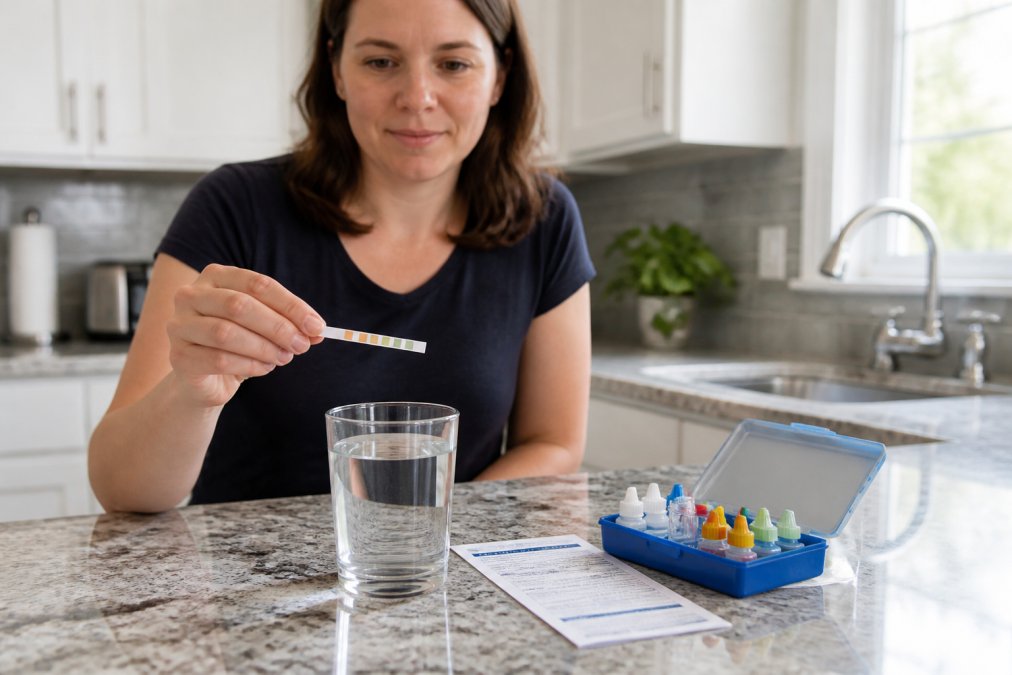
Testing water hardness at home takes minutes and costs little. Three options exist, each suited to a different level of precision.
Water Softener vs Water Conditioner: What's the Difference?
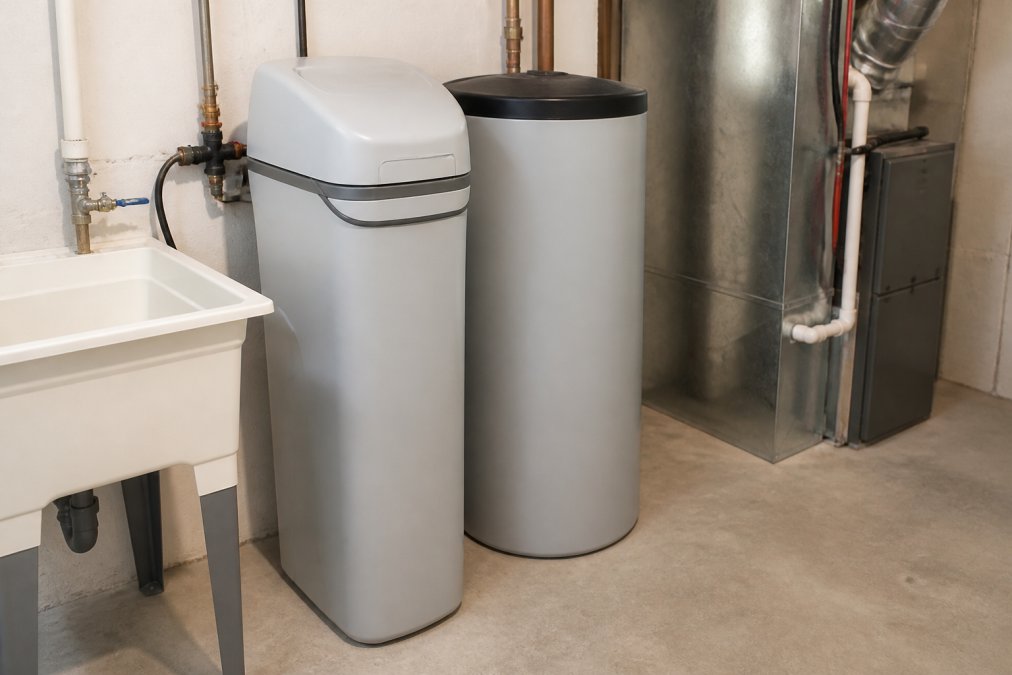
The distinction between a water softener and a water conditioner comes down to chemistry. A water softener removes hardness minerals through ion exchange; a water conditioner alters the minerals or treats the water without removing them. That difference drives everything else, the salt you buy, the water you drink, the wastewater you send down the drain, and whether your shower glass stays clear.
Salt-Based, Salt-Free, and Reverse Osmosis Compared
| System | How It Works | Removes Minerals? | Adds Sodium? | Wastewater? | Best For |
|---|---|---|---|---|---|
| Salt-based softener | Ion exchange with resin and brine tank | Yes | Yes, trace amounts | Yes, during regeneration | Whole-home scale control |
| Salt-free conditioner (TAC) | Crystallization changes mineral behavior | No | No | No | Households avoiding salt discharge |
| Reverse osmosis | Forces water through a fine membrane | Yes, at point of use | No | Yes, at point of use | Drinking water at a single tap |
Salt-based systems deliver the most complete scale protection, at the cost of the salt you add and the discharge regeneration sends into wastewater. Salt-free conditioners avoid that discharge but don't remove the minerals. Reverse osmosis is a point-of-use tool: very pure drinking water at one faucet, but not designed to protect your whole plumbing system from scale.
The Sodium Question Nobody Asks About
Ion exchange swaps calcium and magnesium for sodium. The amount added is small but not zero, and it scales with how hard your source water is. For most households it's minor compared to dietary sources, but if anyone in the home is on a sodium-restricted diet, raise it with a physician before you buy. The workaround: soften the whole house, then run a reverse osmosis unit at the kitchen tap for drinking and cooking water, scale protection in the pipes, low-sodium water in the glass.
The Salt Discharge Trade-Off
Regeneration sends a concentrated brine solution into your wastewater. On a municipal sewer system, that load is diluted at the treatment plant; on a septic system, the extra sodium and chloride can affect the tank's bacterial balance over time. Several states and jurisdictions have restricted new salt-based softener installations in certain watersheds, so check your local rules before you commit.
The Real Costs: DIY vs Professional Installation
Cost is where most buying decisions stall, and honest numbers are hard to find. Pricing varies widely by system type, home size, and local labor rates, so treat any single figure quoted online with skepticism. What you can compare is the shape of the decision, and the factors that move the number up or down.
What Actually Drives the Price
Four variables explain most of the spread between quotes:
- System type. A basic salt-based softener costs far less than a high-efficiency, demand-initiated unit with a digital meter. Salt-free conditioners sit in a different price band.
- Capacity (grain rating). Capacity is sized to your household, not your house. A common rule of thumb: multiply the number of people by roughly 75-100 gallons per person per day, multiply by your hardness in grains per gallon, then add a buffer for a week between regenerations. A family of four on 10 gpg water needs a meaningfully larger unit than a single occupant on 5 gpg.
- Installation complexity. Connecting to an existing softener loop or nearby cold-water line is a different job than running new plumbing across a basement or tying into a well pressure tank.
- Local labor rates. Plumbing labor varies significantly by region and by whether the work is permitted and inspected.
Because those variables interact, a whole-home salt-based system installed professionally typically lands in the low four figures, while a DIY install of a comparable unit can cut that substantially, but only if you own the tools and know how to sweat a copper joint or work with PEX.
DIY vs. Professional: A Decision Framework
DIY installation saves on labor and suits handy homeowners comfortable with basic plumbing. The risks are real: a poorly sealed connection can leak, a wrongly sized system won't perform as expected, and nobody confirms your water chemistry before the equipment goes in.
A practical way to decide:
- Lean DIY if you have a pre-existing softener loop, a single-story layout with accessible plumbing, and prior experience with supply lines and shutoff valves.
- Lean professional if you're on a private well, if the install requires a new drain line for regeneration discharge, if your local code requires a permit and inspection, or if you're not confident you can size the unit correctly.
- Always professional if your water source is a well with a pressure tank, if you have galvanized or polybutylene plumbing, or if the unit will be installed somewhere that a leak would cause significant water damage.
Ongoing Costs Most Buyers Forget
Installation is the entry fee, not the total. Salt-based systems need a steady supply of softener salt, pellets or crystals, plus periodic resin cleaning and eventual replacement of the resin bed or control valve. Salt-free conditioners have lower consumable costs but may need scheduled media replacement. Reverse osmosis systems require membrane and filter changes. Budget for annual consumables, not just hardware, or the system will quietly stop performing.
Renters and Eco-Conscious Households: What Are Your Options?
Renters face a genuine constraint: you can't install a whole-home system in a property you don't own. The practical options are smaller and more targeted.
- Point-of-use filters for drinking and cooking, which address contaminants without touching the building's plumbing
- Shower filters that reduce some mineral and chlorine exposure at the fixture
- Portable softening attachments for individual appliances, though results vary
- A conversation with your landlord about whether whole-home treatment is feasible, some landlords will split the cost if scale is damaging their water heater
When a Water Softener Isn't the Answer
If you're unsure which category your water falls into, professional testing removes the guesswork. A EPA resource on private well and drinking water can help you understand what to test for, and a certified specialist can interpret the results for your specific situation.
Frequently Asked Questions
Is it okay to not have a water softener?
It depends on your water hardness. If your water measures below 3.5 grains per gallon (gpg), a water softener is usually unnecessary and you can manage minor scale with routine cleaning. Above 7 gpg, mineral buildup starts shortening appliance lifespan and increasing water heater energy use. The only way to know is to test your water, not guess based on taste or neighborhood reputation.
Does city water require a water softener?
Municipal water supplies are treated for safety, not softened. Many city systems deliver water in the 5 to 15 gpg range because calcium and magnesium occur naturally in source water. That means city water can still leave scale in your plumbing fixtures and water heater. Testing your specific municipal supply is the only way to know whether a water softener is worth it for your home.
What are the signs of hard water in my home?
Common signs of hard water include white, chalky buildup on faucets and showerheads, soap scum on tubs and glass doors, spotty dishes after washing, stiff laundry, and reduced water flow rate from mineral buildup in pipes. You may also notice dry skin or dull hair after showering. If you see two or more of these, a water hardness test will confirm the cause.
What is a good alternative to a water softener?
If you rent or want to avoid salt discharge, consider a salt-free water conditioner, which changes how minerals behave rather than removing them, or a point-of-use reverse osmosis system for drinking water. Whole-house water filtration can also reduce sediment and chlorine. Each option solves a different problem, so match the technology to what your water test actually shows.
Frequently Asked Questions
Is it okay to not have a water softener?
It depends on your water hardness. If your water measures below 3.5 grains per gallon (gpg), a water softener is usually unnecessary and you can manage minor scale with routine cleaning. Above 7 gpg, mineral buildup starts shortening appliance lifespan and increasing water heater energy use. The only way to know is to test your water, not guess based on taste or neighborhood reputation.
Does city water require a water softener?
Municipal water supplies are treated for safety, not softened. Many city systems deliver water in the 5 to 15 gpg range because calcium and magnesium occur naturally in source water. That means city water can still leave scale in your plumbing fixtures and water heater. Testing your specific municipal supply is the only way to know whether a water softener is worth it for your home.
What are the signs of hard water in my home?
Common signs of hard water include white, chalky buildup on faucets and showerheads, soap scum on tubs and glass doors, spotty dishes after washing, stiff laundry, and reduced water flow rate from mineral buildup in pipes. You may also notice dry skin or dull hair after showering. If you see two or more of these, a water hardness test will confirm the cause.
What is a good alternative to a water softener?
If you rent or want to avoid salt discharge, consider a salt-free water conditioner, which changes how minerals behave rather than removing them, or a point-of-use reverse osmosis system for drinking water. Whole-house water filtration can also reduce sediment and chlorine. Each option solves a different problem, so match the technology to what your water test actually shows.