Table of Contents
- How Lead Enters Municipal Water Systems
- Health Effects of Lead on Children and Adults
- Symptoms of Lead Poisoning and Blood Lead Level Testing
- How to Test Home Water for Lead
- EPA Lead and Copper Rule: What It Means for Your Tap Water
- NSF Certified Water Filters for Lead: Choosing the Right System
- Reducing Lead Exposure at Home: Flushing, Filtration, and Remediation Costs
- What Most Guides Get Wrong
- Frequently Asked Questions
Last Updated: September 25, 2026
How Lead Enters Municipal Water Systems
Lead in municipal water is rarely a problem with the water source itself. It is a problem with the pipes the water travels through. According to the EPA's Lead and Copper Rule guidance, lead enters drinking water primarily through corrosion of plumbing materials, not from the treatment plant that supplies it.
Service Lines, Solders, and Fittings
Three components account for most lead contamination in municipal systems:
- Service lines: The pipe connecting your home to the main under the street. Many older cities still have lead service lines in the ground.
- Solders and fittings: Lead solder was common in household plumbing installed before the 1980s.
- Brass fixtures: Older faucets and valves can contain lead that leaches into standing water.
Health Effects of Lead on Children and Adults
Lead is a neurotoxin with no safe blood lead level in children, according to the CDC's childhood lead poisoning prevention guidance. The body stores it in bones and teeth, where it accumulates over time through bioaccumulation, releasing back into the bloodstream long after exposure ends.
Developmental Delays and Cognitive Impairment in Children
For young children, even low-level chronic exposure is linked to reduced attention span, lower IQ scores, and developmental delays. Because infants and toddlers put hands and objects in their mouths, ingestion is the primary route, and formula mixed with lead-contaminated tap water concentrates exposure in the most vulnerable group.
Hypertension and Renal Effects in Adults
In adults, chronic lead exposure is associated with hypertension, reduced renal function, and reproductive concerns. Effects build slowly, and many adults carry elevated blood lead levels for years without connecting symptoms to their water.
Symptoms of Lead Poisoning and Blood Lead Level Testing
Most lead poisoning is invisible. The EPA's basic information on lead in drinking water notes that lead is odorless, colorless, and tasteless, so you cannot detect it by looking at or drinking your water.
- Children: irritability, fatigue, abdominal pain, constipation, anemia, learning difficulties
- Adults: high blood pressure, joint and muscle pain, memory problems, mood changes, reduced kidney function
How to Test Home Water for Lead
The only way to know whether your tap water contains lead is to test it. But not all tests are equal, the difference between a reliable result and false security comes down to the method, the lab, and how you collect the sample.
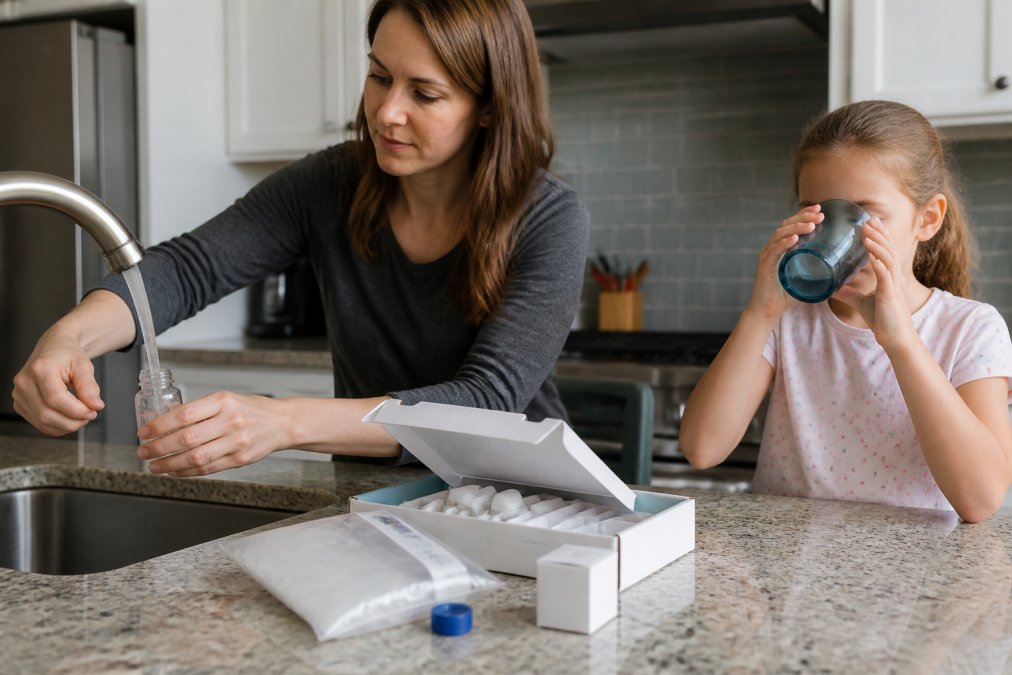
Why Most At-Home Lead Test Kits Fail You
Hardware-store color-change strips and drop-count kits marketed for lead mostly cannot detect it at the concentrations that matter. The EPA action level is 15 parts per billion (ppb), and the CDC has stated no safe blood lead level in children exists, so a "zero" on a strip that only resolves to 15 or 20 ppb tells you almost nothing.
Three common failure modes are:
- Detection floor too high. Many strips are calibrated for industrial or well-water screening, not the low-level chronic exposure that matters in a home with lead solder or a lead service line.
- Interference from other metals. Iron, copper, and zinc in older plumbing can trigger color changes that look like lead.
- No chain of custody. A strip result is not defensible if you later need to show a landlord, a pediatrician, or a utility that your water is contaminated.
Certified Lab Testing: What to Look For
For an actionable result, use a lab accredited under the EPA's National Lead Laboratory Accreditation Program (NLLAP) or a state-certified drinking water lab. These analyze by ICP-MS or graphite furnace atomic absorption, sensitive to the low single-digit ppb range.
When you order a kit, confirm three things:
- The lab is accredited for lead in drinking water, not just for paint or soil.
- The reporting limit is at or below 1 ppb, so you can see low-level contamination, not just a pass/fail against 15 ppb.
- The kit includes a first-draw sampling protocol, because that is the sample that matters most.
How to Collect a First-Draw Sample Correctly
Lead concentrations are highest in water that has sat in pipes for hours. A running-tap sample will almost always look clean, even with a lead service line.
- Collect first thing in the morning, before anyone has used a faucet, flushed a toilet, or run a dishwasher.
- Use the cold-water tap only. Hot water dissolves more lead.
- Fill the bottle to the line, cap it, and ship or drop it off within the lab's stated window.
- If you want a fuller picture, ask the lab about a sequential sampling kit, collecting multiple bottles after increasing flush times shows whether lead is coming from your service line, your interior plumbing, or a specific fixture.
When to Retest
Retest after plumbing work, a move, a utility treatment change, or any child's elevated blood lead level. If your first result is low but your home was built before 1986, retesting in a different season is reasonable, water chemistry and corrosion rates shift.
EPA Lead and Copper Rule: What It Means for Your Tap Water
The EPA Lead and Copper Rule sets an action level for lead in drinking water and requires utilities to monitor and treat for corrosion. When lead exceeds the action level, utilities must act, corrosion control, public notification, and in some cases replacing lead service lines.
NSF Certified Water Filters for Lead: Choosing the Right System
The most reliable way to reduce lead at the tap is a filter certified to remove it. But "certified" misleads most shoppers, because the certification that matters for lead is specific and the box rarely says which one applies.
The Two Certifications That Actually Cover Lead
- NSF/ANSI 53 covers health effects, including lead reduction. A filter certified to NSF 53 for lead must reduce lead to 10 ppb or less in the test water, below the EPA action level of 15 ppb.
- NSF/ANSI 58 covers reverse osmosis systems and also includes a lead-reduction claim.
- NSF/ANSI 42 covers taste and odor only. A filter with a 42 claim and no 53 or 58 claim is not certified for lead, no matter what the front of the package implies.
A filter can carry both 42 and 53 claims. What you are looking for is the specific line on the certification listing that reads "Lead Reduction" under NSF/ANSI 53 or NSF/ANSI 58.
How to Verify a Claim in Under Two Minutes
Do not trust the box. Search the manufacturer or model number in the NSF certification listings. The listing shows:
- The exact standard (42, 53, 58, or a combination)
- The specific contaminants the unit is certified to reduce
- The rated capacity in gallons and the flow rate the certification was tested at
Matching Filter Type to Your Situation
| Filter Type | Lead Reduction | Typical Use | Trade-offs |
|---|---|---|---|
| Reverse osmosis (NSF 58) | High | Under-sink, whole-home point-of-entry | Uses water, needs drain line, higher upfront cost |
| Carbon block (NSF 53) | Moderate to high | Under-sink or pitcher | Must be replaced on schedule; capacity varies widely |
| Distillation | High | Countertop, small volumes | Slow, energy-intensive, flat-tasting water |
| Faucet-mount (NSF 53) | Varies by model | Renter-friendly, low cost | Low capacity, frequent cartridge changes |
| Basic pitcher (no NSF 53/58) | Unverified | , | Not recommended for lead |
For renters or anyone who cannot modify plumbing, a faucet-mount or pitcher unit certified to NSF 53 for lead is the practical starting point. For homeowners already dealing with a known lead service line, an under-sink reverse osmosis unit certified to NSF 58 gives the broadest reduction and the most consistent performance.
What Certification Does Not Tell You
Certification is a performance floor, not a guarantee for your water. Three limits matter:
- Capacity. A certified filter stops performing to spec once it is exhausted. If your water has high sediment or hardness, cartridges can clog before their rated gallonage.
- Flow rate. Certification is tested at a stated flow rate. If you run water faster than that, contact time drops and lead reduction can fall off.
- Point of use vs. point of entry. A certified under-sink filter protects one tap. If you mix formula, cook, or fill pets' bowls from multiple taps, you need coverage at each one, or a point-of-entry system.
A Practical Sequence
- Test first with an accredited lab to confirm whether lead is present and at what level.
- Identify which taps your household actually drinks and cooks from.
- Choose a filter type certified to NSF 53 or 58 for lead that covers those taps.
- Set a cartridge replacement reminder based on the rated capacity, not the calendar.
- Retest after installation to confirm the filter is doing what the certification promises in your water.
Reducing Lead Exposure at Home: Flushing, Filtration, and Remediation Costs
Three practical steps reduce lead exposure immediately, and one addresses the problem permanently.
- Flush your lines. Run cold water for several minutes before drinking or cooking, especially in the morning. Never use hot tap water for drinking, cooking, or mixing formula, since heat increases lead leaching.
- Filter at the tap. Use an NSF-certified filter for the water you actually consume.
- Test regularly. Retest after any plumbing work, a move, or a change in your utility's treatment.
What Most Guides Get Wrong
Generic lead advice stops at "run your tap." That helps, but it does not tell you whether your specific home has a problem or whether your filter actually works. Data-driven testing answers both questions. If you want to know exactly what is in your water before spending money on equipment, [the CDC's water testing(https://healthyh2osolutions.com/water-testing/) resources | cdc.gov] and a certified lab are the place to start.
Frequently Asked Questions
How long does it take for lead in water to affect your health?
There is no safe blood lead level, and health effects can build over months or years of exposure. Children exposed to lead in municipal water may show developmental delays or cognitive impairment within a year, while adults can develop hypertension or reduced renal function after prolonged ingestion. Because lead bioaccumulates, even low parts per billion (ppb) levels matter. If you suspect exposure, ask your doctor for a blood lead level test and stop drinking unfiltered tap water until you have results from a certified lab.
What is the EPA action level for lead in drinking water?
The EPA lead and copper rule sets the action level at 15 parts per billion (ppb) for lead in tap water. When more than 10% of sampled homes exceed that level, the water utility must take steps like corrosion control treatment, public notification, and potentially replacing lead service lines. The action level is not a health-based maximum; it is a trigger for regulatory response. Even water below 15 ppb can still pose risks, especially for children and pregnant women, so NSF certified water filters for lead are worth considering regardless of your utility's compliance status.
How can I tell if my home has lead service lines?
Check the pipe that connects your home to the municipal main, usually in the basement or where the water line enters. Lead pipes are dull gray, soft enough to scratch with a key, and do not attract a magnet. You can also ask your water utility for their service line inventory, which many are required to publish under the EPA lead and copper rule. If you cannot confirm the material, a certified lab can test water samples, and a plumber can inspect the line. Homes built before 1986 are most likely to have lead solders or fittings.
Can you safely shower or bathe in water that contains lead?
Showering and bathing are generally considered safe because lead is not absorbed through intact skin. The main risk comes from ingestion, so avoid swallowing water while bathing, and do not use hot tap water for cooking or mixing baby formula. However, lead in water can still be inhaled as aerosolized droplets in steam, and young children may swallow bathwater. If your water tests high for lead, consider a whole-home filter or at minimum use a certified filter for drinking and cooking water. Testing your water is the first step to knowing your actual exposure risk.
Frequently Asked Questions
How long does it take for lead in water to affect your health?
There is no safe blood lead level, and health effects can build over months or years of exposure. Children exposed to lead in municipal water may show developmental delays or cognitive impairment within a year, while adults can develop hypertension or reduced renal function after prolonged ingestion. Because lead bioaccumulates, even low parts per billion (ppb) levels matter. If you suspect exposure, ask your doctor for a blood lead level test and stop drinking unfiltered tap water until you have results from a certified lab.
What is the EPA action level for lead in drinking water?
The EPA lead and copper rule sets the action level at 15 parts per billion (ppb) for lead in tap water. When more than 10% of sampled homes exceed that level, the water utility must take steps like corrosion control treatment, public notification, and potentially replacing lead service lines. The action level is not a health-based maximum; it is a trigger for regulatory response. Even water below 15 ppb can still pose risks, especially for children and pregnant women, so NSF certified water filters for lead are worth considering regardless of your utility's compliance status.
How can I tell if my home has lead service lines?
Check the pipe that connects your home to the municipal main, usually in the basement or where the water line enters. Lead pipes are dull gray, soft enough to scratch with a key, and do not attract a magnet. You can also ask your water utility for their service line inventory, which many are required to publish under the EPA lead and copper rule. If you cannot confirm the material, a certified lab can test water samples, and a plumber can inspect the line. Homes built before 1986 are most likely to have lead solders or fittings.
Can you safely shower or bathe in water that contains lead?
Showering and bathing are generally considered safe because lead is not absorbed through intact skin. The main risk comes from ingestion, so avoid swallowing water while bathing, and do not use hot tap water for cooking or mixing baby formula. However, lead in water can still be inhaled as aerosolized droplets in steam, and young children may swallow bathwater. If your water tests high for lead, consider a whole-home filter or at minimum use a certified filter for drinking and cooking water. Testing your water is the first step to knowing your actual exposure risk.