Table of Contents
- What Are Microplastics in Drinking Water?
- How Water Filters Remove Microplastics
- NSF/ANSI 401 Microplastics Certification Explained
- Reverse Osmosis vs. Carbon Block for Microplastics
- How to Test Water for Microplastics
- Key Features to Look for in a Microplastic-Reducing Filter
- Filter Disposal and Environmental Impact
- Frequently Asked Questions
Last Updated: September 29, 2026
What Are Microplastics in Drinking Water?
Microplastics are tiny plastic particles smaller than 5 millimeters that have contaminated water supplies worldwide (Integrated science for the study of microplastics in the environment, A strategic science...). These fragments come from the breakdown of larger plastic items, synthetic textiles, tire wear, and industrial processes. When you drink unfiltered tap water, you're likely consuming microplastics along with it.
Microplastics can carry harmful chemicals like PFAS and heavy metals that bind to their surfaces. Your digestive system doesn't break down plastic, so these particles pass through your body.
Microplastics have been found in both municipal and well water systems, adding to your body's overall toxic burden.
How Water Filters Remove Microplastics
Water filters eliminate microplastics through mechanical filtration by forcing water through media with pore sizes small enough to trap particles. Effectiveness depends on pore size (measured in microns), water pressure, and filtration media density.
Micron Rating and Particle Size
Microplastics range from 5 millimeters down to 1 micrometer. A filter's micron rating indicates the smallest particle it can reliably capture. For practical microplastic reduction, filters rated at 0.5 to 1 micron represent the balance most households need; finer filters are typically found only in reverse osmosis systems.
Filtration Media Types and Their Mechanisms
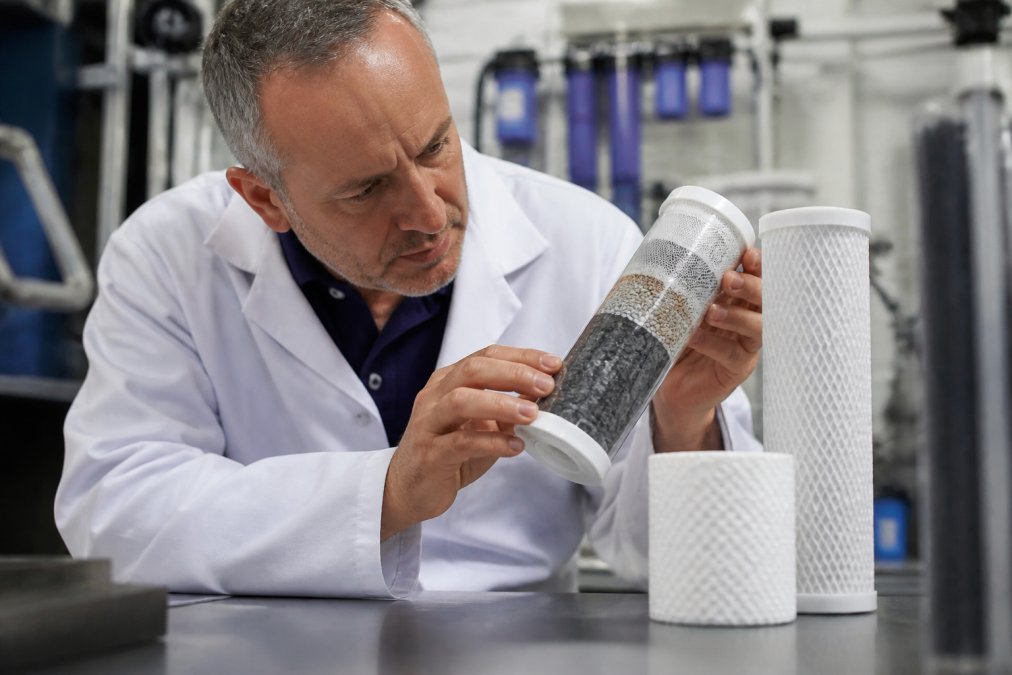
Activated carbon block filters work through mechanical sieving and adsorption. Carbon is particularly effective because microplastics often carry PFAS and heavy metals; the carbon removes both the particle and the chemicals simultaneously. A 0.5-micron carbon block filter can reduce microplastics by 85-95%.
Ceramic filters are denser than carbon and create more resistance to water flow, making them common in gravity-fed systems. Polypropylene filters allow faster flow but may not capture particles as effectively at the same micron rating.
Reverse osmosis uses a semipermeable membrane with pores around 0.0001 microns. Water molecules pass through under pressure, but microplastics and most contaminants cannot. Reverse osmosis removes 95-99% of microplastics but requires 3-4 gallons of water to produce 1 gallon of filtered water.
The Flow Rate and Pressure Trade-Off
Finer filtration reduces flow rate due to greater resistance. A 1-micron pitcher filter delivers 0.5 gallons per minute, while reverse osmosis delivers 0.1-0.2 gallons per minute. Filters designed for faster flow may allow more microplastics to pass through.
Municipal water pressure (typically 40-80 psi) is sufficient for carbon block and reverse osmosis filters. Low-pressure situations can reduce filter performance because water moves through the media too quickly.
Multi-Stage Filtration
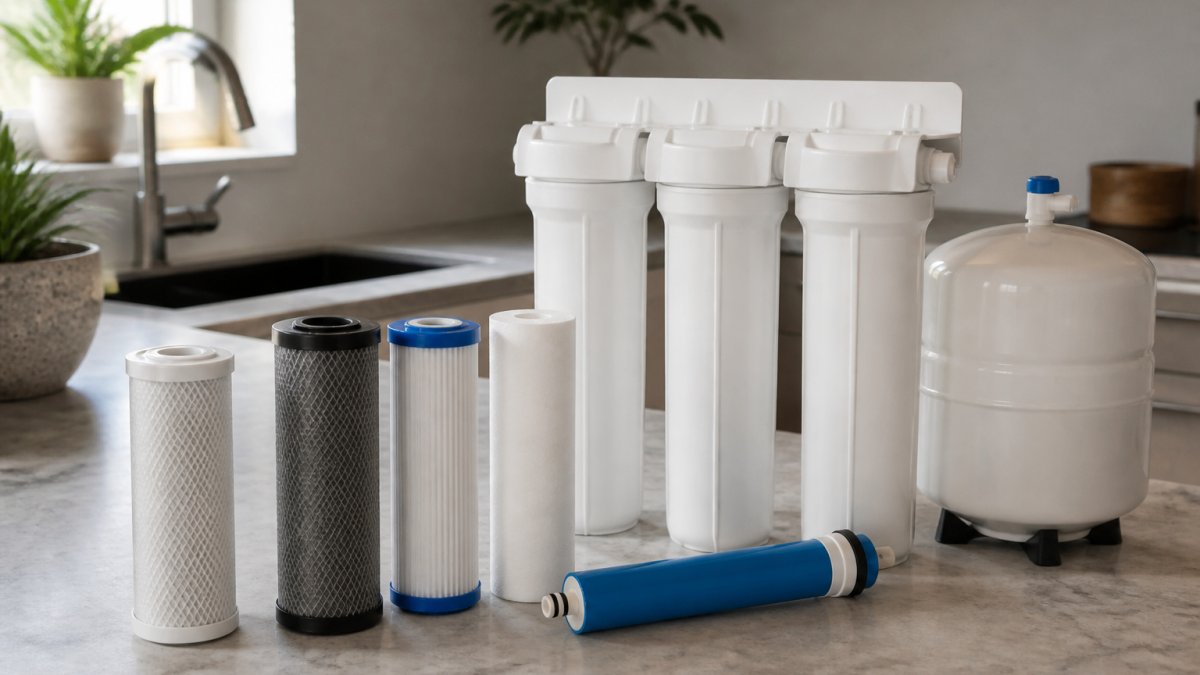
Multi-stage filters use layered media optimized for different particle sizes. A typical under-sink system includes a 5-micron sediment pre-filter, a 0.5-micron carbon block, and sometimes a post-filter. This approach extends cartridge life by capturing larger debris before it clogs finer stages.
NSF/ANSI 401 Microplastics Certification Explained
NSF/ANSI 401 is the certification standard that specifically tests filters for microplastics reduction, focusing on synthetic polymer removal.
To earn NSF/ANSI 401 certification, a filter must be tested by an independent laboratory using synthetic microplastics. A certified filter has proven performance data, not just marketing claims.
Many filters claim to reduce microplastics but lack NSF/ANSI 401 certification. General NSF certification for chlorine or heavy metals doesn't guarantee microplastic reduction.
Reverse osmosis systems and high-quality carbon block filters are most likely to carry NSF/ANSI 401 certification. When you're comparing best water filtration for microplastics options, this certification should be your first filter. If a product doesn't mention NSF/ANSI 401, ask the manufacturer directly whether their filter has been tested for microplastic reduction.
Reverse Osmosis vs. Carbon Block for Microplastics
Reverse osmosis and carbon block filters represent two distinct approaches to microplastic reduction, each with measurable performance differences and real-world trade-offs. Understanding the distinction requires clarity on what each system actually removes and what it leaves behind.
Removal Efficiency and the Nanoplastic Question
Reverse osmosis removes 95-99% of microplastics because its semipermeable membrane has pores approximately 0.0001 microns, far smaller than any microplastic particle.
Carbon block filters with NSF/ANSI 401 certification remove 85-95% of microplastics. A 0.5-micron carbon block filter is highly effective for particles larger than 0.5 microns but may allow nanoplastics to pass through. If your concern is the absolute smallest particles, reverse osmosis provides greater certainty of removal.
Most municipal water testing focuses on microplastics in the 1-100 micrometer range, where carbon block filters perform comparably to reverse osmosis.
Water Waste and Environmental Cost
Reverse osmosis systems produce significant wastewater: 3-4 gallons wasted for every 1 gallon filtered. Over a year, a household may waste 5,000-10,000 gallons annually, creating financial and environmental liability in water-scarce regions.
Carbon block filters produce no wastewater. All water entering the system either passes through the filter or is captured by the cartridge (as contaminants). This makes carbon block more sustainable and cost-effective in water-conscious regions.
Installation, Maintenance, and Ongoing Costs
Carbon block filters are available in pitcher, faucet-mounted, or under-sink forms. Replacement cartridges cost $30-$80 and last 2-6 months, with annual costs of $120-$480.
Reverse osmosis systems require professional installation ($200-$500) and annual replacement costs of $100-$200. A storage tank and possible booster pump add $150-$300. Total first-year cost ranges from $500-$1,000, compared to $50-$200 for carbon block.
Flow Rate and Daily Usability
Carbon block filters deliver 0.5-1.5 gallons per minute, making them practical for filling glasses and cooking. Reverse osmosis systems deliver 0.1-0.3 gallons per minute, meaning it may take 5-10 minutes to fill a pitcher or 30+ minutes to fill a bathtub for cleaning. For households with high water demand or multiple users, reverse osmosis's slow flow rate becomes a daily frustration.
When to Choose Each System
Choose reverse osmosis if:
- Your water test shows high microplastic contamination (above 10 particles per liter) or confirmed nanoplastic presence
- You have a dedicated drinking-water tap and can tolerate slow fill times
- You can manage the wastewater (or live in a region with abundant water)
- You want the highest possible removal rate and are willing to pay for it
- You also need to remove dissolved solids, high levels of PFAS, or other contaminants that carbon alone cannot address
Choose carbon block if:
- Your water test shows moderate microplastic levels (1-10 particles per liter)
- You prioritize ease of installation and maintenance
- You want to minimize water waste and ongoing costs
- You rent or move frequently and need portability
- You also want to reduce PFAS and heavy metals without the wastewater penalty
- You live in a water-conscious region or have high municipal water costs
How to Test Water for Microplastics
Testing your water reveals whether microplastics are actually present in your supply. Many homeowners assume their water is safe without testing, then discover microplastics when they finally check. Testing removes guesswork and guides your filtration decision.
You can send a water sample to a certified lab that tests for synthetic polymer particles. The lab uses spectroscopy to identify and count microplastics in your sample.
Key Features to Look for in a Microplastic-Reducing Filter
Start with NSF/ANSI 401 certification. This single feature tells you the filter has been independently tested for microplastic reduction. Without it, you're relying on manufacturer claims with no third-party verification.
Filter Disposal and Environmental Impact
Used water filter cartridges create an environmental problem many people overlook. Most filters end up in landfills where the plastic media and captured contaminants persist for decades. If your filter captured microplastics and heavy metals, those pollutants remain in the landfill indefinitely.
Frequently Asked Questions
Which water filter removes the most microplastics?
Reverse osmosis systems remove the highest percentage of microplastics due to their extremely small pore size (0.0001 microns). Under-sink reverse osmosis units certified to NSF/ANSI 401 standards provide the most reliable microplastic reduction. Carbon block filters and gravity-fed systems with certified performance ratings also remove microplastics effectively, though typically at lower rates than reverse osmosis. The best choice depends on your water pressure, flow rate needs, and budget. Testing your specific water helps identify which filtration method matches your contamination level.
How do I know if my water filter is certified for microplastic reduction?
Look for NSF/ANSI 401 certification on the product packaging or manufacturer's website. This standard specifically tests filtration media for synthetic polymer reduction, including microplastics and nanoplastics. The certification verifies that the filter meets contaminant reduction claims through independent testing. You can verify certification status on the NSF International website. Certified performance means the filter has been tested under controlled conditions and proven to reduce particulate matter and polymers. If certification information isn't clearly stated, contact the manufacturer directly or request third-party lab testing results.
Do water filters themselves contribute to microplastic contamination?
Quality filters made from food-grade polypropylene and certified materials do not shed microplastics into your water. However, low-quality or damaged filters may deteriorate and release particles. Using certified filters from reputable manufacturers minimizes this risk significantly. Proper cartridge replacement according to manufacturer guidelines prevents filter degradation. If you're concerned about filter integrity, certified lab water testing can detect whether your filtered water contains microplastics, confirming whether your system is performing as intended.
Can I test my own water for microplastics at home?
Home test kits for microplastics exist but have limited accuracy compared to certified lab analysis. Professional lab testing uses advanced equipment like spectroscopy and microscopy to identify particle size, type, and concentration with precision. Certified water testing provides the most reliable data for making filtration decisions. If you suspect microplastic contamination or want to verify your filter's effectiveness, certified lab testing gives you confidence in the results and helps you choose the right filtration approach for your specific water quality.
Frequently Asked Questions
Which water filter removes the most microplastics?
Reverse osmosis systems remove the highest percentage of microplastics due to their extremely small pore size (0.0001 microns). Under-sink reverse osmosis units certified to NSF/ANSI 401 standards provide the most reliable microplastic reduction. Carbon block filters and gravity-fed systems with certified performance ratings also remove microplastics effectively, though typically at lower rates than reverse osmosis. The best choice depends on your water pressure, flow rate needs, and budget. Testing your specific water helps identify which filtration method matches your contamination level.
How do I know if my water filter is certified for microplastic reduction?
Look for NSF/ANSI 401 certification on the product packaging or manufacturer's website. This standard specifically tests filtration media for synthetic polymer reduction, including microplastics and nanoplastics. The certification verifies that the filter meets contaminant reduction claims through independent testing. You can verify certification status on the NSF International website. Certified performance means the filter has been tested under controlled conditions and proven to reduce particulate matter and polymers. If certification information isn't clearly stated, contact the manufacturer directly or request third-party lab testing results.
Do water filters themselves contribute to microplastic contamination?
Quality filters made from food-grade polypropylene and certified materials do not shed microplastics into your water. However, low-quality or damaged filters may deteriorate and release particles. Using certified filters from reputable manufacturers minimizes this risk significantly. Proper cartridge replacement according to manufacturer guidelines prevents filter degradation. If you're concerned about filter integrity, certified lab water testing can detect whether your filtered water contains microplastics, confirming whether your system is performing as intended.
Can I test my own water for microplastics at home?
Home test kits for microplastics exist but have limited accuracy compared to certified lab analysis. Professional lab testing uses advanced equipment like spectroscopy and microscopy to identify particle size, type, and concentration with precision. Certified water testing provides the most reliable data for making filtration decisions. If you suspect microplastic contamination or want to verify your filter's effectiveness, certified lab testing gives you confidence in the results and helps you choose the right filtration approach for your specific water quality.