Table of Contents
- How to Find Out If PFAS Are in Your City Water
- EPA PFAS Drinking Water Regulations: What the Limits Mean for You
- How to Test Home Water for PFAS: DIY Kits vs. Certified Labs
- Best Water Filters for PFAS Removal: What Actually Works
- Health Risks of PFAS and Who Is Most Vulnerable
- Financial Assistance for PFAS Remediation and Testing
- Conclusion
- Frequently Asked Questions
Last Updated: September 28, 2026
How to Find Out If PFAS Are in Your City Water
If you are asking "are PFAS in my city water," start with your utility's annual water quality report. This guide from Toxin Free with Rob / Healthy Water Solutions LLC walks you through reading that report, testing your tap, and choosing a filter that works.
Reading Your Consumer Confidence Report
Every public water system must mail you a Consumer Confidence Report each year, listing what was detected in your water and at what levels.
Look for these items:
- The detection column for PFAS compounds
- Results listed in parts per trillion (ppt)
- Any health advisory notes from your state
- The date the samples were collected
EPA PFAS Drinking Water Regulations: What the Limits Mean for You
The EPA set enforceable limits for several PFAS compounds in drinking water, called maximum contaminant levels (MCLs). Water systems must monitor for them and treat the water if levels run too high.
Here is what the rules mean in plain terms:
- Your water utility must test for these chemicals
- Results must be shared with the public
- Systems above the limit must reduce levels
- Compliance monitoring happens on a set schedule
| What You See | What It Means | Your Next Step |
|---|---|---|
| "Not detected" | Below lab reporting limit | Retest yearly |
| Detected, below limit | Present but within rules | Consider a filter |
| Above the limit | System must treat water | Filter now, ask your utility |
How to Test Home Water for PFAS: DIY Kits vs. Certified Labs
Your utility's report tells you what left the treatment plant, not what comes out of your kitchen faucet after traveling through service lines and older plumbing. For proof at the tap, you have two paths: DIY kits and certified lab analysis. They are not interchangeable, and the difference matters more for PFAS than for almost any other contaminant.
Why DIY Strip Tests Usually Fail for PFAS
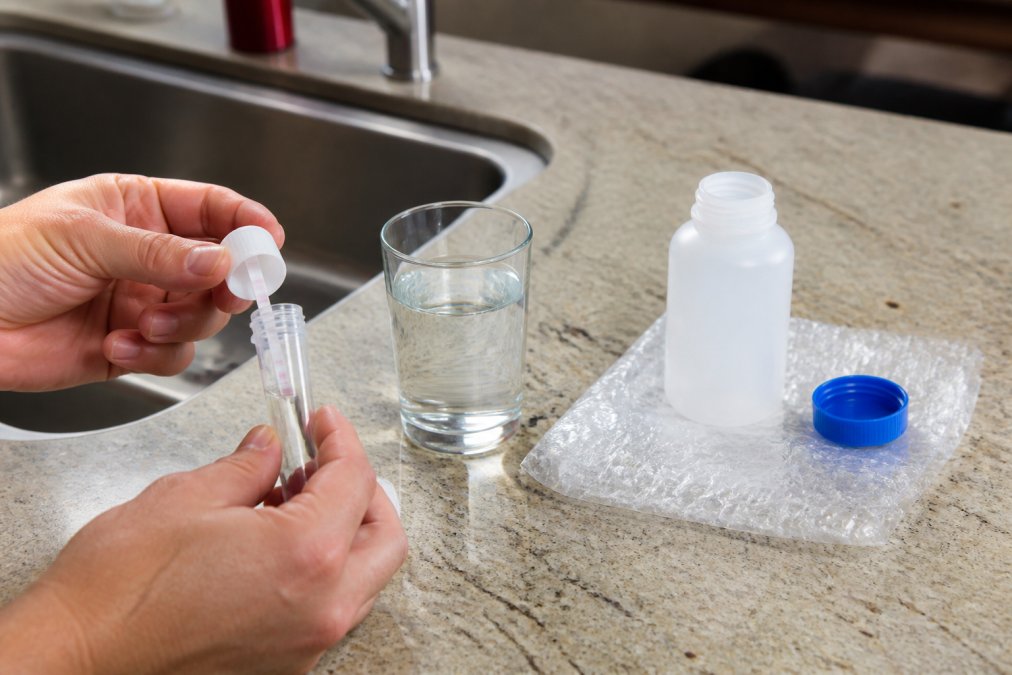
Most at-home strip and color-change kits screen for chlorine, hardness, pH, or total dissolved solids, not PFAS at the concentrations that matter. The EPA's health-based goals for PFOA and PFOS are measured in parts per trillion (ppt), far below what a dip strip can resolve. A strip that reads "clear" is not evidence your water is PFAS-free; it usually means the strip was never capable of detecting the compound.
What Certified Lab Testing Actually Involves
Certified labs analyze PFAS using EPA-approved methods, most commonly the method designated for drinking water under the agency's PFAS testing program, detecting individual compounds at single-digit parts-per-trillion levels. This is the only way to know exactly which compounds are present and at what concentration.
A typical certified test works like this:
- The lab ships you a pre-cleaned sample bottle with preservative already in it
- You collect the sample following the lab's written instructions
- You ship it back within the holding time, usually with overnight delivery
- The lab runs the analysis and returns a report listing each compound and its result in ppt
How Do You Collect a PFAS Sample Correctly?
Cross-contamination is the biggest cause of bad PFAS results. These chemicals are used in waterproofing, stain-resistant fabrics, and some cosmetics, so a sample can be ruined before it reaches the lab.
A few rules that matter:
- Do not touch the inside of the bottle or the cap threads
- Wash your hands and avoid lotions, sunscreen, or waterproof clothing on collection day
- Let the water run per the lab's instructions before filling
- Fill the bottle to the line the lab specifies, no more, no less
- Ship within the holding time, not the next business day after
When Professional Testing Makes Sense
Professional testing is worth the cost when:
- You have a private well, which is not covered by any utility report
- Your utility report shows a detection, even below the limit
- You have young children, are pregnant, or are planning a pregnancy
- You live near a known contamination site such as a former military base or manufacturing facility
- You are about to spend money on a filter and want to match it to real results
At Toxin Free with Rob / Healthy Water Solutions LLC, testing starts with your goals. We look at your water source, your family, and your budget before recommending anything. This education-first step keeps you from buying equipment you do not need.
Reading Your Lab Report Without a Chemistry Degree
When results come back, look for three things: which compounds were detected, the concentration in ppt, and the lab's reporting limit. "Not detected" means the compound was below the reporting limit, not absent. If that limit is higher than the EPA's health-based goal, a "not detected" result is less reassuring than it sounds, so ask the lab for its reporting limit per compound before drawing conclusions.
Best Water Filters for PFAS Removal: What Actually Works
Not all filters remove PFAS, and the ones that do are not equally effective against every compound. The two technologies with the strongest track record are activated carbon and reverse osmosis; a third, ion exchange, is used in some whole-home and point-of-entry systems. Here is how they work and where each falls short.
Activated Carbon: Good, Affordable, and Cartridge-Dependent
Activated carbon traps many PFAS compounds as water passes through the media. It is the basis for most pitcher filters, faucet mounts, refrigerator filters, and whole-home carbon systems, affordable and easy to install.
Reverse Osmosis: The Strongest Home Option
Reverse osmosis pushes water through a fine membrane that rejects a wide range of contaminants, including PFAS, lead, and microplastics. Typically installed as a point-of-use system under the kitchen sink, sometimes with a carbon pre-filter to protect the membrane, it costs more upfront, uses more water per gallon produced, and requires periodic membrane and filter replacement, but for drinking water at the tap, it is the most thorough option most homeowners can install.
Ion Exchange: A Third Path
Ion exchange resins, sometimes paired with carbon, are used in some whole-home and point-of-entry systems. They can be effective against certain PFAS compounds, but performance depends on the resin and system design. If you are considering a whole-home system, ask the manufacturer for PFAS-specific removal data, not general contaminant claims.
How the Main Types Compare
| Filter Type | PFAS Removal | Best For | Watch Out For |
|---|---|---|---|
| Activated carbon (pitcher, faucet, fridge) | Good for longer-chain PFAS; variable for shorter-chain | Basic reduction at low cost | Cartridge changes; shorter-chain gaps |
| Whole-home carbon | Good for longer-chain PFAS | Reducing PFAS at every tap | Higher cost; media replacement |
| Reverse osmosis (point-of-use) | Strong across a wide range of PFAS | Drinking water at the tap | Water waste, upfront cost, membrane changes |
| Ion exchange | Varies by resin and system | Whole-home or point-of-entry | Ask for PFAS-specific data |
| Pitcher filters (basic) | Limited | Taste and odor | Weak on PFAS |
| Faucet mounts | Varies | Small kitchens | Check certification |
Match the Filter to Your Test Result, Not the Marketing
A filter that improves taste does not always remove PFAS. Start with your lab report: if PFOA and PFOS are above the EPA's health-based goal, reverse osmosis at the kitchen tap is the most direct response. A low-level detection of longer-chain compounds may only need a certified carbon filter. A private well with multiple detections may call for a whole-home or point-of-entry system rather than a single faucet filter.
Health Risks of PFAS and Who Is Most Vulnerable
PFAS stay in the body and build up over time, bioaccumulation. Research has linked high exposure to health issues including effects on the liver, immune system, and cholesterol levels.
Who faces the most risk?
- Young children, who drink more water per pound of body weight
- Pregnant people and developing babies
- Families on private wells with no testing
- Anyone living near a known contamination site
Financial Assistance for PFAS Remediation and Testing
Cost is a real barrier, and most guides skip it. Here is what to know.
A few practical paths:
- Ask your water utility about treatment plans and timelines
- Contact your state drinking water program about assistance
- Check whether your homeowner's insurance covers testing
- Look into community programs near known contamination sites
Conclusion
The question "are PFAS in my city water" has a real answer, and you can find it. Start with your Consumer Confidence Report, confirm with a certified lab test, and match your filter to the results.
Frequently Asked Questions
How do I know if my water contains PFAS?
Start by finding your water utility's annual Consumer Confidence Report, which lists detected contaminants. If PFAS are not listed, it may be because testing was not required or results fell below reporting thresholds. The most reliable way to know is to test your home water for PFAS through a certified lab. Look for labs using EPA Method 533 or 537.1, which detect PFAS at parts per trillion levels.
Can standard home water filters remove PFAS?
Not all filters are equal. Basic pitcher filters and standard carbon cartridges may not remove PFAS effectively. For meaningful reduction, look for filters certified to NSF/ANSI 53 or NSF/ANSI 58 for PFAS removal. Reverse osmosis systems and activated carbon filters specifically rated for PFAS are your best options. Always check the certification label to confirm the filter meets the standard for the specific PFAS compounds you are targeting.
What should I do if PFAS is detected in my municipal water supply?
First, review the levels reported and compare them to the EPA's enforceable Maximum Contaminant Levels. If levels exceed the limits, your utility is required to take action. In the meantime, install a point-of-use or point-of-entry filtration system certified for PFAS removal. If you have young children or are pregnant, consider using bottled water for drinking and cooking until filtration is in place. Contact your utility for a timeline on remediation.
How often do water utilities test for PFAS?
Under the EPA's Unregulated Contaminant Monitoring Rule, many utilities conducted initial PFAS testing between 2018 and 2020. With the 2024 drinking water standards, public water systems must now conduct compliance monitoring. Larger systems typically test quarterly, while smaller systems may test less frequently. Check your utility's Consumer Confidence Report or contact them directly to learn their specific testing schedule and most recent results.
Frequently Asked Questions
How do I know if my water contains PFAS?
Start by finding your water utility's annual Consumer Confidence Report, which lists detected contaminants. If PFAS are not listed, it may be because testing was not required or results fell below reporting thresholds. The most reliable way to know is to test your home water for PFAS through a certified lab. Look for labs using EPA Method 533 or 537.1, which detect PFAS at parts per trillion levels.
Can standard home water filters remove PFAS?
Not all filters are equal. Basic pitcher filters and standard carbon cartridges may not remove PFAS effectively. For meaningful reduction, look for filters certified to NSF/ANSI 53 or NSF/ANSI 58 for PFAS removal. Reverse osmosis systems and activated carbon filters specifically rated for PFAS are your best options. Always check the certification label to confirm the filter meets the standard for the specific PFAS compounds you are targeting.
What should I do if PFAS is detected in my municipal water supply?
First, review the levels reported and compare them to the EPA's enforceable Maximum Contaminant Levels. If levels exceed the limits, your utility is required to take action. In the meantime, install a point-of-use or point-of-entry filtration system certified for PFAS removal. If you have young children or are pregnant, consider using bottled water for drinking and cooking until filtration is in place. Contact your utility for a timeline on remediation.
How often do water utilities test for PFAS?
Under the EPA's Unregulated Contaminant Monitoring Rule, many utilities conducted initial PFAS testing between 2018 and 2020. With the 2024 drinking water standards, public water systems must now conduct compliance monitoring. Larger systems typically test quarterly, while smaller systems may test less frequently. Check your utility's Consumer Confidence Report or contact them directly to learn their specific testing schedule and most recent results.