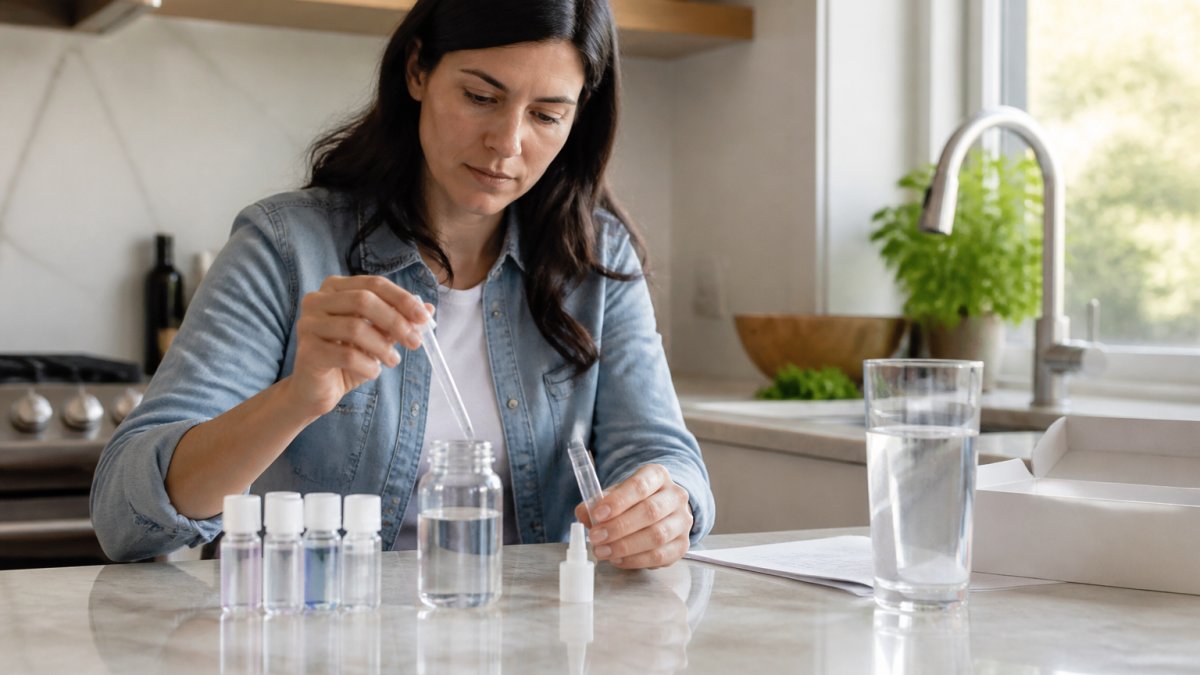
Table of Contents
- Why Companies Offer Free Water Tests
- Free Water Tests vs. Certified Lab Water Testing
- The Dangers of Microplastics in Drinking Water
- Common Contaminants Free Tests Miss
- How to Interpret Water Quality Reports
- DIY Sampling Errors That Skew Results
- When to Get Professional Water Testing
- Frequently Asked Questions
Last Updated: September 30, 2026
Why Companies Offer Free Water Tests
Free water tests are not a public service, and understanding why they exist is the first step toward understanding whether you can trust them. In most cases, a free test is a sales tool attached to a filtration quote, which means the "results" arrive with a recommendation already baked in.
That doesn't make every free test worthless. It does mean the incentive structure runs against you. A technician paid on commission has little reason to tell you your water is fine.
At Toxin Free with Rob, we hear this concern constantly from homeowners: "I'm worried you'll just push me toward an expensive system I don't need." It's a fair question, and it's exactly why education-first testing matters.
Free Water Tests vs. Certified Lab Water Testing
Free tests and certified lab testing answer different questions. A free kit tells you roughly what's present; a certified lab tells you how much, at what concentration, and whether that level matters for your household. That distinction, qualitative screening versus quantitative measurement, is the single most important thing to understand before you trust any result.
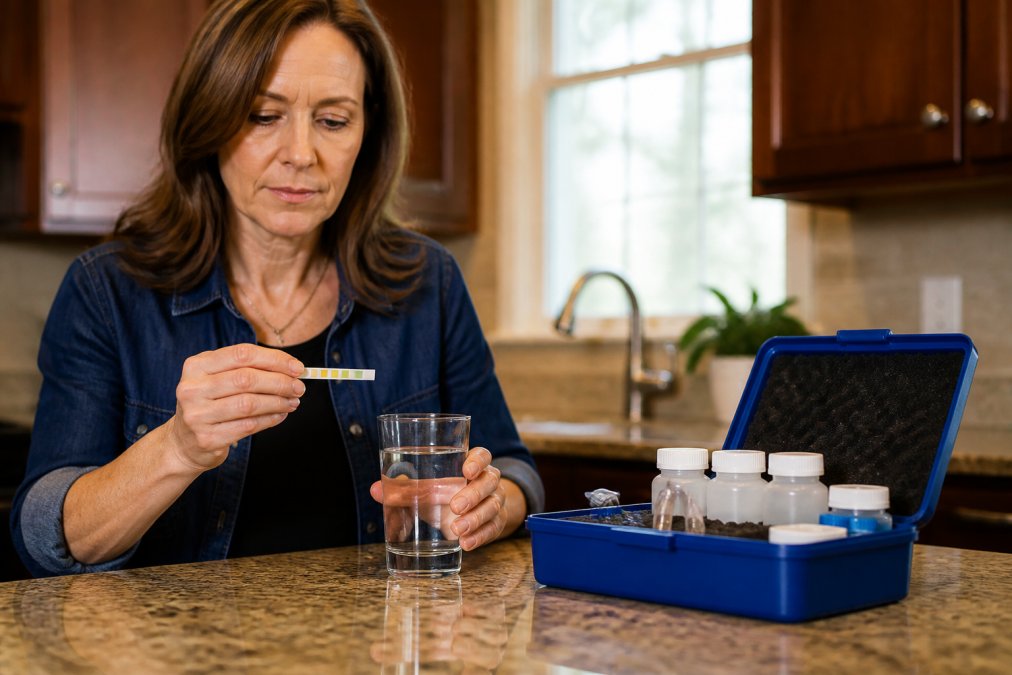
The comparison below captures the practical differences.
| Feature | Free Test Kit | Certified Lab Testing |
|---|---|---|
| Cost | Free (with sales visit) | Paid, varies by panel |
| Method | Test strips or handheld meters | Laboratory-grade analysis (ICP-MS, GC-MS, culture) |
| Measurement type | Qualitative screening | Quantitative measurement |
| Detection limits | High (misses low levels) | Low (parts per billion or lower) |
| Results | On the spot, often verbal | Written report with numbers and method references |
| Bias | Tied to a sales pitch | Independent of equipment sales |
| Chain of custody | None | Documented sample handling |
What Test Strips and Free Kits Can and Cannot Detect
Test strips work by a colorimetric reaction: a reagent pad changes color when it contacts a target substance, and you match that color to a chart. That mechanism limits them to contaminants that react visibly with the pad chemistry, total hardness, rough pH, and sometimes chlorine residuals or nitrates at high concentrations. For a quick sanity check, that's genuinely useful.
Understanding Detection Limits and False Results
Detection limit is the lowest concentration an analytical method can reliably distinguish from zero. A strip with a detection limit of 10 parts per million cannot see a lead level of 5 parts per billion, even though that level is still a real concern. The gap between a strip's detection limit and a health-based benchmark is often two or three orders of magnitude.
Regulatory Compliance vs. Health-Optimal Standards
One gap free kits and even some utility reports leave open is the difference between legal and health-optimal. The EPA sets enforceable Maximum Contaminant Levels (MCLs) and non-enforceable Maximum Contaminant Level Goals (MCLGs). For lead, the MCLG is zero, because no safe level has been identified, yet the enforceable action level is not zero. A result can be fully compliant and still above the level many health practitioners would prefer for a household with young children.
The Dangers of Microplastics in Drinking Water
Microplastics are one of the fastest-growing concerns in household water, and they are almost entirely invisible to free test kits. The World Health Organization's report on microplastics in drinking water notes that these particles are widespread in both tap and bottled water, and that standard consumer tests don't screen for them at all.
Common Contaminants Free Tests Miss
The contaminants that matter most for family health are usually the ones a free kit can't see. That gap is the core reason "are free water tests accurate" has a short answer: they're accurate for a narrow slice of water chemistry and silent on everything else.
Lead, PFAS, and Other Heavy Metals
Lead typically enters water through service lines and household plumbing, not the source supply, which means two homes on the same street can have different results. The EPA's Lead and Copper Rule resources explain how corrosion control and pipe material drive exposure.
Coliform Bacteria and Pathogenic Organisms
Coliform bacteria and other pathogenic organisms need a culture or molecular test, not a color strip. A free kit may include a bacteria vial, but without proper incubation and lab handling, results are unreliable.
How to Interpret Water Quality Reports
Reading a water quality report correctly is a skill, and it's one most homeowners never learn. Utilities publish the data; interpreting it is on you.
Reading Your Annual Consumer Confidence Report
Your utility's annual Consumer Confidence Report lists detected contaminants, their measured levels, and the legal limit for each. The key columns are "detected level," "MCL" (maximum contaminant level), and "MCLG" (goal).
Why TDS Meters Don't Tell the Full Story
Total dissolved solids (TDS) is the combined weight of all dissolved substances in water, including beneficial minerals. A high TDS reading does not mean the water is unsafe, and a low reading does not mean it's clean.
DIY Sampling Errors That Skew Results
Sampling errors are the quiet killer of accurate water testing, and they happen even with certified labs. If the sample is collected wrong, the result is wrong, no matter how good the analysis is.
Common mistakes include:
- Collecting from a faucet that hasn't run long enough, which traps contaminants sitting in the pipes.
- Using a contaminated container or touching the inside of the lid.
- Sampling from a filtered tap when you meant to test the raw supply.
- Letting a bacteria sample sit warm for hours before shipping.
- Failing to follow first-draw instructions for lead testing, which require water that has sat undisturbed.
When to Get Professional Water Testing
Professional testing is worth it when the stakes are high: young children in the home, a private well, a new property, or any suspicion of lead or PFAS. But "get a professional test" is not a complete answer. The more useful question is how do you verify water safety through a channel that has no financial interest in the result?
Start With Your Consumer Confidence Report, Not a Test Kit
Before you buy any test, pull your utility's annual Consumer Confidence Report (CCR). It's free, it's required, and it tells you what the utility already detected and at what levels. Use it as a screening tool:
- Scan the detected-contaminant table for anything at or near its MCL.
- Note contaminants the CCR does not cover, lead and copper are typically reported as a 90th-percentile value across the system, not at your tap, and PFAS reporting has expanded only recently.
- Identify the specific contaminants your source and plumbing make plausible, then test for those, not for everything.
Choose a Certified Lab, Not a Sales Visit
For a result you can act on, use a laboratory certified by your state's drinking water program or accredited under a recognized program such as NELAP. Certification means the lab's methods and detection limits have been independently verified. A sales-visit test has no such oversight, and the person reading it may be compensated on whether you buy equipment.
Match the Test to the Risk
- Lead: first-draw sample from the tap you drink from, after the water has sat undisturbed for at least six hours.
- Bacteria (well owners): routine testing on a schedule, not a one-time check, because contamination can be intermittent.
- PFAS: a panel that specifically lists PFAS compounds and their individual detection limits, a general "organics" screen won't do it.
- Private well: a baseline panel plus annual bacteria and nitrate testing, since no utility is monitoring your supply.
What to Do With the Numbers
Once you have quantitative results, compare each one against two benchmarks: the enforceable MCL and the non-enforceable health goal. A result below the MCL is legal; whether it's acceptable for your household is a judgment call you can now make with real data instead of a color chart.
Frequently Asked Questions
How accurate are free water test kits provided by retailers?
Free water test kits from retailers typically use test strips or basic chemical reagents that provide only qualitative screening. They can indicate the presence of some contaminants but cannot measure exact concentrations. Most lack the sensitivity to detect lead at the EPA action level of 15 parts per billion or PFAS at parts per trillion. These kits are often marketing tools designed to generate a sales visit, not to give you reliable data about your water quality.
What is the difference between a screening test and certified lab water testing?
A screening test gives you a yes-or-no or rough range for a limited set of contaminants. Certified lab water testing uses EPA-approved methods and analytical instruments to measure exact concentrations of specific contaminants. Labs follow strict sampling protocols, maintain chain-of-custody documentation, and report results in units that match regulatory standards. For decisions about your family's health, lab-grade analysis is the only way to get data you can act on.
Can home test strips detect lead and PFAS?
Home test strips cannot reliably detect lead or PFAS at the levels that matter for health. Lead requires detection at 15 parts per billion or lower, and PFAS compounds are measured in parts per trillion. Test strips operate at much higher detection limits, often missing contamination entirely. If you are concerned about lead or PFAS, you need certified lab water testing using methods like EPA 200.8 for lead or EPA 537 for PFAS.
Why do some companies offer free water testing?
Free water testing is typically a sales tactic. A technician visits your home, runs a basic test that often shows elevated total dissolved solids or hardness, and uses those results to recommend a water treatment system. The test is designed to create concern, not to provide accurate data. Legitimate water quality assessment comes from certified lab water testing, where results are independent of any filtration equipment purchase.
Frequently Asked Questions
How accurate are free water test kits provided by retailers?
Free water test kits from retailers typically use test strips or basic chemical reagents that provide only qualitative screening. They can indicate the presence of some contaminants but cannot measure exact concentrations. Most lack the sensitivity to detect lead at the EPA action level of 15 parts per billion or PFAS at parts per trillion. These kits are often marketing tools designed to generate a sales visit, not to give you reliable data about your water quality.
What is the difference between a screening test and certified lab water testing?
A screening test gives you a yes-or-no or rough range for a limited set of contaminants. Certified lab water testing uses EPA-approved methods and analytical instruments to measure exact concentrations of specific contaminants. Labs follow strict sampling protocols, maintain chain-of-custody documentation, and report results in units that match regulatory standards. For decisions about your family's health, lab-grade analysis is the only way to get data you can act on.
Can home test strips detect lead and PFAS?
Home test strips cannot reliably detect lead or PFAS at the levels that matter for health. Lead requires detection at 15 parts per billion or lower, and PFAS compounds are measured in parts per trillion. Test strips operate at much higher detection limits, often missing contamination entirely. If you are concerned about lead or PFAS, you need certified lab water testing using methods like EPA 200.8 for lead or EPA 537 for PFAS.
Why do some companies offer free water testing?
Free water testing is typically a sales tactic. A technician visits your home, runs a basic test that often shows elevated total dissolved solids or hardness, and uses those results to recommend a water treatment system. The test is designed to create concern, not to provide accurate data. Legitimate water quality assessment comes from certified lab water testing, where results are independent of any filtration equipment purchase.